
CUSTOMER SERVICE AND FEEDBACK POLICY
Standards for accessible, fair and accountable customer service, comments, compliments and complaints
Purpose and Policy Statement
The Parish of St Saviour is committed to delivering high-quality, accessible, professional and responsive services to parishioners, ratepayers, visitors, businesses, partner organisations and all other people who interact with the Parish.
Customer service is not a separate activity: it is an integral part of the planning, resourcing and delivery of every Parish service. We want customers to be able to access services easily, receive accurate information, understand what will happen next, and be treated fairly and respectfully throughout their dealings with us.
We value feedback, whether positive or negative. Comments, compliments and complaints help the Parish understand what is working well, identify where services or processes can be improved, and demonstrate accountability to the community.
Scope
This policy applies to all Parish employees, elected and honorary office holders when acting on behalf of the Parish, volunteers, contractors and any person delivering a Parish service on our behalf, subject to any separate statutory, disciplinary or governance procedure that applies.
For the purposes of this policy, a customer includes any person or organisation that contacts, receives a service from, visits, works with or is otherwise affected by a Parish service.
What this policy covers
- Customer service standards across face-to-face, telephone, written and digital channels;
- Comments and suggestions about Parish services;
- Compliments recognising good service or exceptional performance;
- Complaints about service delivery, delay, administrative action, decisions, conduct or failure to act where the matter falls within the Parish’s responsibility;
- How feedback is recorded, reviewed, escalated and used for continuous improvement
Our customer service principles
Our customer service principles reflect the Parish’s wider core values. They guide how we make decisions, communicate with the public, manage resources and deliver services.
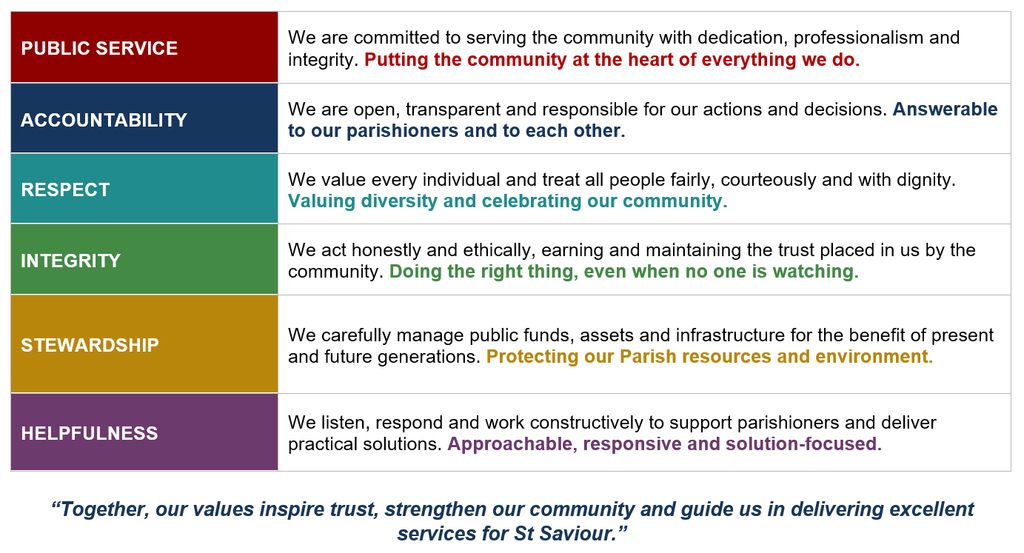
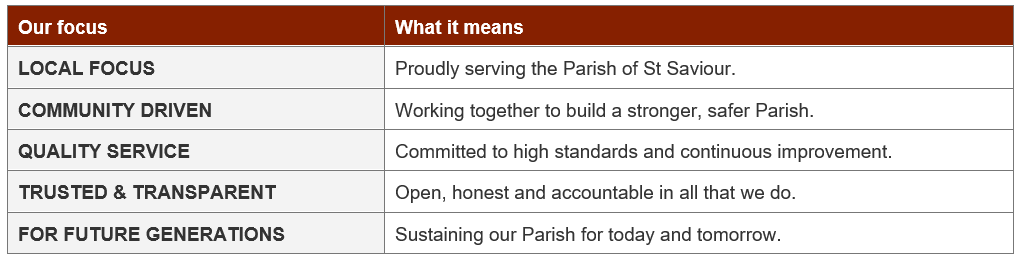
These principles support a local focus, community-driven service, high standards, openness and trust, and responsible planning for future generations.
Shared responsibility
Good customer service works best when both the Parish and the customer engage constructively. The Parish will act professionally, fairly and respectfully; in return, customers are expected to provide accurate information, allow a reasonable opportunity for enquiries to be investigated or services to be put right, and treat staff and other service users with courtesy and respect.
Customer service standards
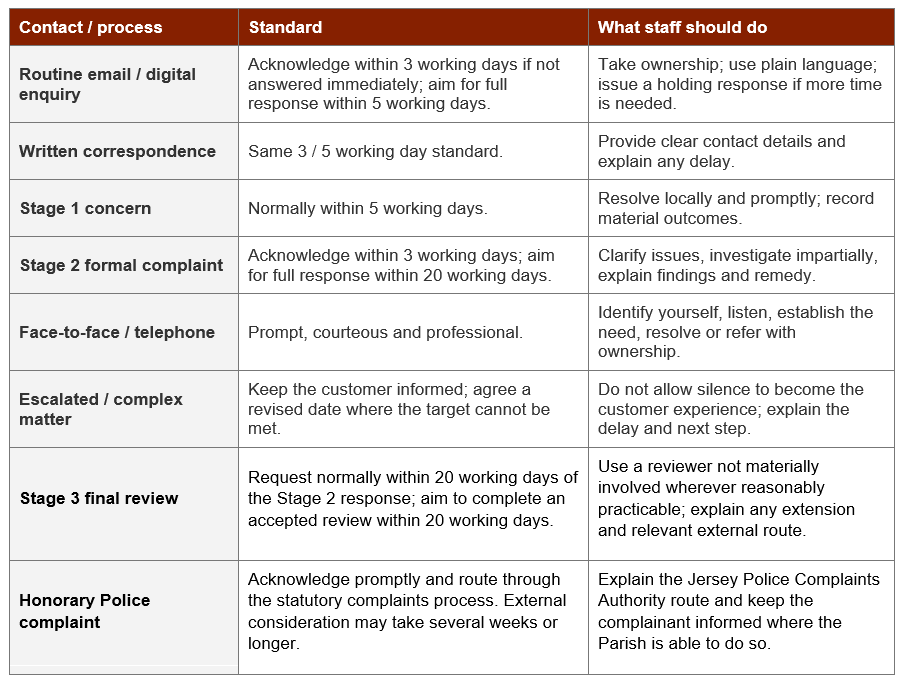
The standards below are the Parish’s minimum corporate expectations and service targets. They are intended to promote consistency and accountability, but do not override statutory timescales or guarantee that every matter can be concluded within the target period. Where a target cannot be met, the customer will be informed of the reason and given a revised response date
General standards
- Identify ourselves and the Parish when dealing directly with customers;
- Be courteous, professional, positive and well informed;
- Listen carefully and establish what the customer is asking us to do;
- Provide accurate, up-to-date information and explain where a request cannot be met;
- Resolve enquiries at the first point of contact where reasonably possible;
- Record contact details accurately where a record is required;
- Keep customers informed where further action or referral is needed;
- Treat customers fairly and consistently while recognising individual circumstances and accessibility needs;
- Protect confidential and personal information in accordance with applicable Jersey data protection requirements.
Face-to-face contact
- Greet customers promptly and politely;
- Give the customer our full attention and explain any likely waiting time;
- Offer an appointment where this would be more appropriate or efficient;
- Where sensitive or personal matters are discussed, use a private environment where practicable;
- Employees attending homes, sites or businesses on Parish business should identify themselves appropriately.
Telephone contact
- Answer calls promptly where operationally possible, give our name and identify the Parish;
- Take ownership of the call and resolve the enquiry where possible;
- If transferring a call, explain why and, where practicable, identify the person or team receiving the call;
- Where an immediate answer is not possible, take an accurate message and arrange a call-back;
- Voicemail messages should be clear, current and provide alternative contact information where appropriate.
Email, website and digital contact
- Acknowledge substantive written or digital enquiries within 3 working days where an immediate response is not possible;
- Aim to provide a full response to routine correspondence within 5 working days;
- Where a full response cannot be provided within that period, issue a holding response explaining the reason and expected response date;
- Use clear, professional language and appropriate Parish signature and contact information;
- Social media is a communication channel, but not every public comment will require an individual response. Matters requiring personal information or detailed case handling should be moved to an appropriate private channel.
Written correspondence
The same 3-working-day acknowledgement and 5-working-day routine response standards apply to letters and other formal written enquiries, unless another statutory or published timescale applies.
Customer Feedback: Comments and compliments
Comments and suggestions
A comment is feedback, an observation or a suggestion that does not require a complaint investigation. Comments may relate to how a service is delivered, how information is presented or how the Parish could improve an activity or process.
Relevant comments should be referred to the service manager responsible and, where useful, recorded as part of service improvement activity.
Compliments
A compliment is an expression of praise or recognition about a Parish service, employee, elected or honorary office holder, volunteer or team. Compliments should be recorded and shared with the individuals and managers concerned so that good practice can be recognised and, where appropriate, replicated
What is a Complaint?
Service requests and complaints
An initial request for a Parish service, or a first report of a fault or problem, is normally a service request rather than a complaint. The Parish should first be given a reasonable opportunity to provide the service or put the matter right. A service request may become a complaint where the customer is dissatisfied with the Parish’s response, the matter is not addressed appropriately, or the customer expressly asks for the complaint process to be used.
What is a complaint?
A complaint is an expression of dissatisfaction where a customer believes that the Parish, or a person delivering a service on its behalf, has done something wrong, failed to act, provided a poor standard of service, treated the customer unfairly or failed to meet a reasonable service expectation.
A complaint may include dissatisfaction about:
- The standard or quality of a Parish service;
- Failure or delay in providing a service;
- The Parish’s response to a request for service;
- An administrative action or decision;
- The behaviour or conduct of a member of staff while carrying out Parish duties;
- Alleged bias, unfair treatment or discrimination in service delivery;
- Poor communication or failure to keep a customer appropriately informed
Matters outside or separate from this policy
Some matters cannot appropriately be determined through the general complaints process. Where a separate statutory, legal, disciplinary, appeal or governance route exists, the Parish will explain the appropriate route where it is able to do so.
- An initial request for a service that the Parish has not yet had an opportunity to address;
- Matters subject to a separate statutory appeal, court process or other legal remedy;
- Employment, recruitment, grievance or internal disciplinary matters;
- Insurance claims for alleged loss, damage or personal injury, which must follow the relevant claims process;
- Safeguarding matters or matters requiring urgent referral to another competent authority;
- Complaints about organisations, policies or services for which the Parish is not responsible;
- Complaints that have already exhausted the Parish process unless significant new evidence is provided;
- Matters that are so old that a fair investigation is no longer reasonably possible. As a general rule, complaints should be raised within 3 months, although older matters may be considered where there are good reasons and sufficient evidence.
How to contact us
Feedback may be provided in person, by telephone, online, by email or by post. The Parish will ensure that customers are not disadvantaged merely because they cannot use a particular contact channel
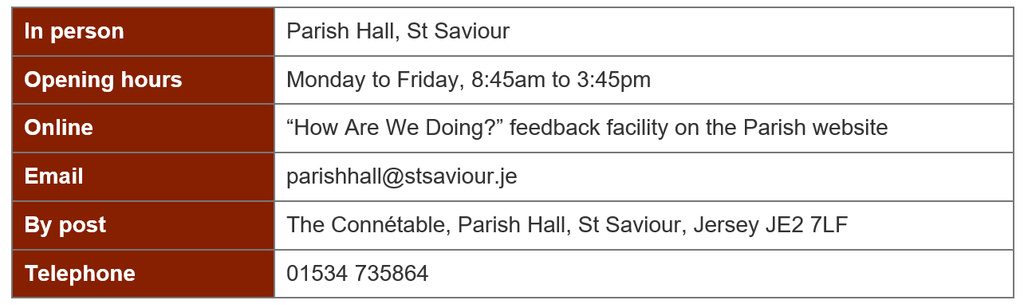
All formal complaints will be logged and handled securely. The Parish may ask for a complaint to be confirmed in writing where this is necessary to understand the issues, establish an audit trail or conduct a fair investigation.
Anonymous complaints
The Parish may consider an anonymous complaint where it contains enough specific information to allow a fair assessment or investigation. However, anonymity may limit the Parish’s ability to verify evidence, clarify the issues or provide an outcome. Safeguarding, criminal or other serious concerns will be referred through the appropriate route where necessary.
Complaint Handling Procedure
Stage 1 – Informal / Local Resolution
Most concerns should be resolved as close as possible to the point of service delivery. Staff and line managers are encouraged to resolve straightforward issues promptly without unnecessarily formalising them.
- The service area should establish what happened and what the customer is seeking;
- Where the matter can be put right immediately, this should be done and explained to the customer;
- The Parish will normally aim to resolve Stage 1 concerns within 5 working days. This is a service target rather than an absolute guarantee;
- Where appropriate, the outcome should be confirmed to the customer and a brief internal record retained.
Stage 2 – Formal Complaint
A matter should move to Stage 2 where informal resolution has not worked, the customer asks for a formal investigation, the issues are serious or complex, or the nature of the complaint makes informal handling inappropriate. A formal complaint should, where possible, include the customer’s name and contact details, a clear description of the issues, relevant dates, any supporting evidence and the outcome being sought
- Acknowledgement: within 3 working days;
- Clarification: if the complaint is unclear, the Parish may contact the customer to agree the issues to be investigated;
- Investigation: an appropriate officer or elected representative will conduct or commission an impartial and proportionate review;
- Response target: the Parish will aim to provide a full written response within 20 working days of acknowledgement;
- Extension: where the investigation is complex or depends on information from others, the customer will be told why more time is needed and given an updated response date;
- Outcome: the response will state whether the complaint is upheld, partly upheld or not upheld, explain the reasons, identify any remedy or action and explain the next step if the customer remains dissatisfied
Stage 3 – Final Review / External Route
If the customer remains dissatisfied after the formal response, they should normally request a final review within 20 working days of the Stage 2 response. The Parish will consider whether a further review is appropriate and what lawful external route, if any, applies to the subject matter. Where a final review is accepted, the Parish will aim to complete it within 20 working days, or will explain why additional time is required and provide a revised response date.
A final internal review should be undertaken by a person who has not been materially involved in the earlier decision wherever this is reasonably practicable. There is no automatic right to repeated internal investigation of the same issues once the Parish’s process has been completed. The final response should identify any further route that is relevant and known to the Parish.
Independence and conflicts of interest
No person should investigate or determine a complaint where they are the subject of it, made the decision complained of, or have a material personal involvement in the matters raised. Where necessary, the Parish will appoint another appropriate officer, elected representative or suitably independent person. Any conflict and the alternative arrangements put in place should be recorded.
Conduct and specialist complaints
Employees
Complaints about members of staff will be considered under this policy to the extent that they concern customer service or service delivery. Allegations that raise internal employment, disciplinary or serious misconduct issues may instead be managed under the Parish’s employment procedures. The Parish will not normally disclose confidential employment information or disciplinary outcomes to a complainant
Elected Officers
Complaints concerning the conduct of an elected Parish officer will be considered in accordance with the relevant legal and governance framework. Where the complaint concerns the Connétable, the matter may need to be referred to an appropriate independent, statutory or legal process rather than determined by the subject of the complaint
Honorary Police
Complaints relating to the Honorary Police are governed by the Police (Complaints and Discipline) (Jersey) Law 1999 and the Police (Honorary Police Complaints and Discipline Procedure) (Jersey) Regulations 2000. The Jersey Police Complaints Authority is an independent organisation established under the Law and provides external oversight of complaints concerning police and Honorary Police officers. The Parish will acknowledge such a complaint promptly, explain or facilitate the appropriate referral and provide updates where it is able to do so. Once the matter enters the statutory complaints process, the Parish’s ordinary 20-working-day response target does not apply. Investigation and independent consideration may take several weeks or longer, depending on the complexity of the case, the evidence required and the timetable of the Authority; those timescales are not controlled by the Parish
Current guidance and contact details are available on the Government of Jersey Jersey Police Complaints Authority webpage
Data protection and confidentiality
Concerns about the handling of personal information will be referred to the appropriate person within the Parish and managed under applicable Jersey data protection requirements. Information about a complaint will be shared only with those who need it to assess, investigate, decide or implement action, subject to legal obligations.
Approach to remedies
Where an investigation identifies fault by the Parish, the objective is to put matters right so far as reasonably possible, address any identifiable injustice or disadvantage caused, and reduce the risk of recurrence.
Depending on the circumstances, remedies may include:
- An explanation or acknowledgement of what went wrong;
- An apology;
- Correction of inaccurate information or completion of an outstanding action;
- Reconsideration or review of an administrative process where lawful and appropriate;
- Changes to procedure, guidance, systems or controls;
- Training, coaching or management action;
- Actions designed to prevent the same problem recurring;
- Where properly evidenced and within the Parish’s legal and financial authority, consideration of direct financial loss or another proportionate remedy.
A remedy should be proportionate to the fault and the impact identified. A complaint outcome does not create authority to make a payment, waive a charge or overturn a lawful decision where the Parish does not otherwise have power to do so.
Unreasonable, Abusive or persistent customer behaviour
The Parish welcomes challenge and recognises that people may be upset, frustrated or distressed when contacting us. Customers have the right to be heard and treated respectfully. Parish employees and representatives have the same right.
Behaviour may be considered unreasonable where the nature or frequency of contact materially hinders the Parish’s ability to deal with the matter, provide services to others or protect staff welfare. Examples may include abusive or threatening language, discriminatory conduct, repeated demands for matters already fully answered, excessive duplication of correspondence, refusal to accept reasonable communication arrangements, or persistent contact that has no reasonable prospect of producing a different outcome.
Any restriction on contact should be proportionate, documented, time-limited where appropriate and communicated to the customer, unless immediate safety concerns make prior notice inappropriate. A manager may put an immediate temporary arrangement in place where this is necessary for safety or service continuity. Any continuing restriction must be authorised by the Executive Officer, Connétable or another appropriately delegated senior officer, and the record must state the reasons, scope, duration and review date. Measures may include a single point of contact, a specified communication channel, limits on frequency of contact or declining to respond to repetitive correspondence that raises no new issues.
Safety: Threats of violence, harassment or conduct presenting an immediate risk to health, safety or welfare may be referred to the appropriate authorities and managed outside the normal complaints process.
Support, Accessibility and Representation
The Parish will take reasonable practical steps to help customers access this policy. A customer may ask another person to assist or correspond on their behalf, subject to appropriate authority and data protection considerations.
Where a customer has difficulty using the normal process, the Parish should consider an alternative communication method, accessible format, additional explanation or other proportionate adjustment that enables the person to participate effectively.
Recording, governance and Learning
Customer feedback is a governance resource as well as a case-management activity. The Parish will maintain proportionate records of formal complaints and material feedback so that it can demonstrate accountability and identify recurring themes.
- Complaints should be recorded with the service area, issue, date, outcome and key actions;
- Actions arising from complaints should be assigned to an owner and monitored to completion;
- Comments, compliments and complaints should be periodically reviewed for patterns, recurring causes and service improvement opportunities;
- Anonymised information may be reported to the Connétable, Procureurs, Roads Committee, Parish Assembly or other appropriate governance body;
- Significant learning should be incorporated into procedures, staff briefings, training, risk controls and service planning where appropriate;
- Senior management will review an anonymised summary of formal complaints, outcomes, response performance, recurring themes and material service improvements at least annually. Publication of summary information will be considered where it is proportionate and useful to the community.
Training and Responsibilities
All staff and Parish representatives
- Understand and apply the customer service principles in this policy;
- Take ownership of customer contact within their role and competence;
- Escalate complaints, risks and safeguarding or legal issues appropriately;
- Maintain confidentiality and accurate records.
Line Managers
- Support early resolution and quality-check responses;
- Ensure complaints are investigated fairly and within target timescales;
- Identify root causes and implement agreed service improvements;
- Monitor customer service standards within their area.
Senior Management / Connétable / Procureurs
- Provide oversight of significant or escalated complaints;
- Ensure appropriate independence and governance in sensitive cases;
- Review trends, performance and learning;
- Approve material changes to policy or corporate service standards.
Review of Policy
This policy will be reviewed every three years, or sooner where changes in legislation, governance arrangements, operational requirements or learning from customer feedback make an earlier review appropriate.
Service standards and operational contact information may be updated administratively between formal policy reviews where this does not alter the underlying policy principles or governance arrangements.
Our Customer Service Promise
Our Promise: We will serve our Parish in accordance with our core principles of Public Service, Accountability, Respect, Integrity, Stewardship and Helpfulness. We will listen, communicate clearly, take ownership, use Parish resources responsibly, resolve issues as early as possible, learn from feedback and continually improve the services we provide to our community
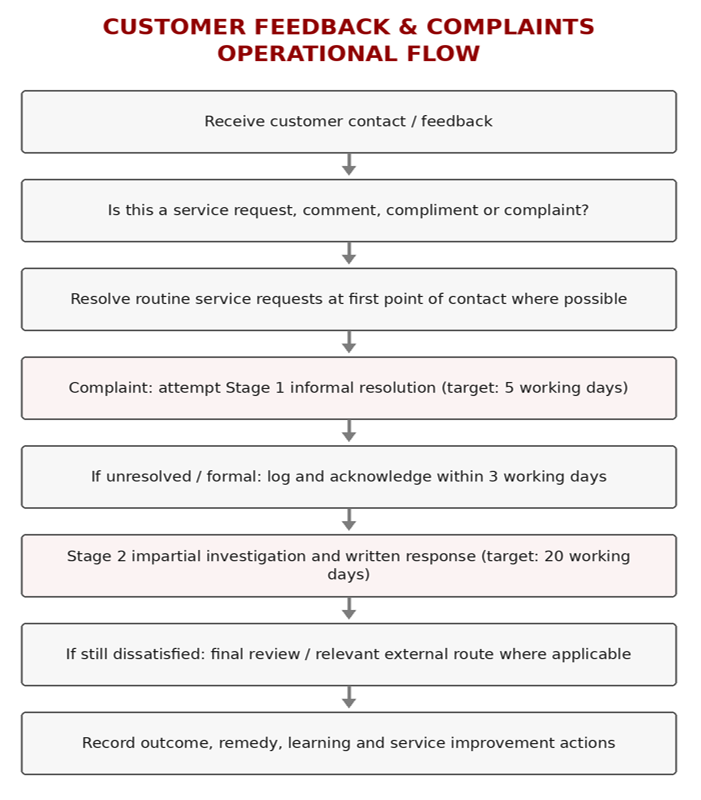
Specialist complaints, including Honorary Police complaints, may be referred into separate statutory processes. Once referred, external investigation and oversight timescales apply and may extend over several weeks or longer
Service Standard Quick Reference
Our Customer Service Response Standards
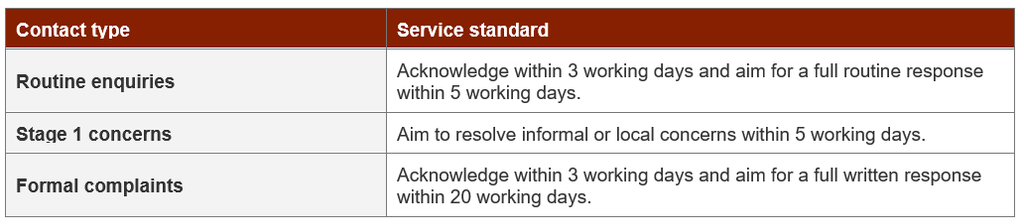
Response times are service targets. If we need more time, we will explain why and provide a revised response date.