A fair, proportionate and legally grounded framework for supporting ratepayers experiencing financial hardship
About this Policy
The Parish of St Saviour recognises that financial pressure can arise unexpectedly. We will administer rates fairly and responsibly, while treating ratepayers with compassion, dignity and professionalism.
This policy explains the support that may be available, the information the Parish may request, how decisions are made and what happens if rates remain unpaid. It does not create an automatic entitlement to relief. Each request is considered on its individual circumstances.
Who this Policy applies to
This policy applies to ratepayers who are liable for Parish or Island-wide rates collected by the Parish of St Saviour and who are having genuine difficulty paying. It covers routine and extended payment arrangements, hardship applications, support referrals, possible reduction or remission, review and proportionate recovery.
It does not decide rateable value, ownership or occupier status, or appeals against a rate assessment. Those matters follow separate procedures under the Rates (Jersey) Law 2005.
Key legal points
Important
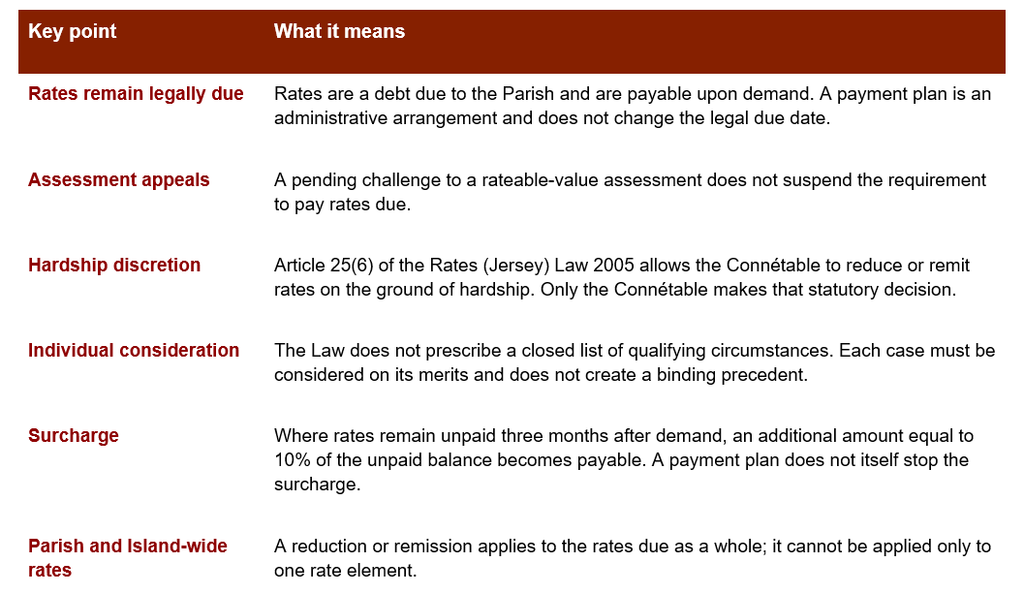
Where hardship relief is requested in relation to a surcharge, the Parish will consider the matter as part of the Connétable’s Article 25(6) hardship discretion. Legal advice may be obtained where necessary.
Our Approach
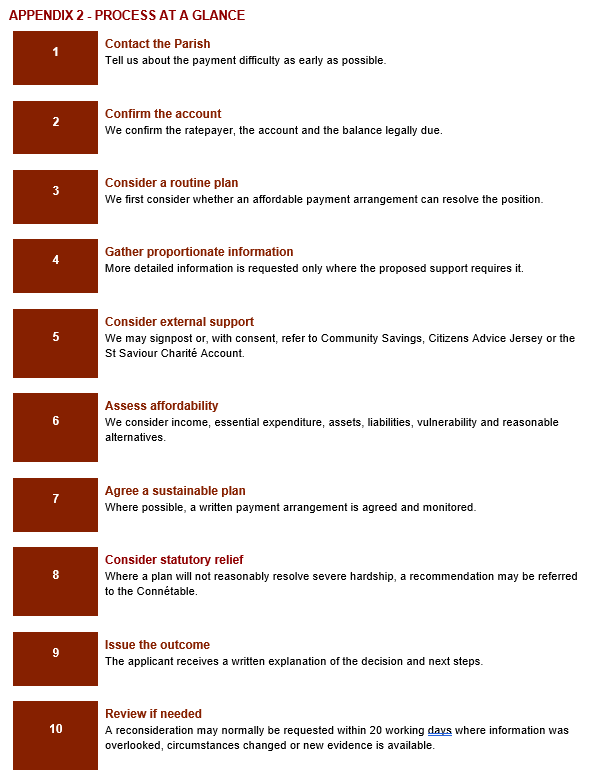
Early contact: Contact us as soon as you think payment may be difficult. You do not need to wait until the rate demand is overdue.
Fairness and consistency: Comparable cases will be approached consistently, while recognising that every person’s circumstances are different.
Proportionate evidence: A routine affordable payment plan should not require the same level of evidence as an extended plan or a request to reduce or remit rates.
Affordable and sustainable outcomes: Where repayment is possible, the arrangement should be realistic and should not knowingly create an unmanageable cycle of arrears
Respect and confidentiality: Applicants will be treated without stigma. Personal information will be requested only where relevant and will be handled securely.
Help the Parish May Offer
Depending on the circumstances, the Parish may consider one or more of the following
- Regular payments or a routine payment plan by standing order, instalments or another agreed method
- An extended payment arrangement, including a plan lasting longer than one year where proportionate financial screening shows that it is realistic and sustainable
- A short administrative pause in active recovery while a genuine application, financial screening or agreed referral is being progressed. This does not change the legal due date or automatically stop surcharge
- Signposting or, with consent, referral to an independent advice or charitable organisation
- A partial reduction of rates authorised by the Connétable where hardship is established
- Remission of all or part of the rates due, used only where justified by the severity of hardship and where a lesser option would not reasonably resolve the position.
Normal starting point
The Parish will normally explore realistic payment options and relevant support before recommending reduction or remission. This is a practical preference, not an absolute condition, and does not restrict the Connétable’s discretion.
Independent and Local Support
Parish staff can explain Parish payment options but do not replace independent debt, financial or legal advice. The organisations below may be able to help.
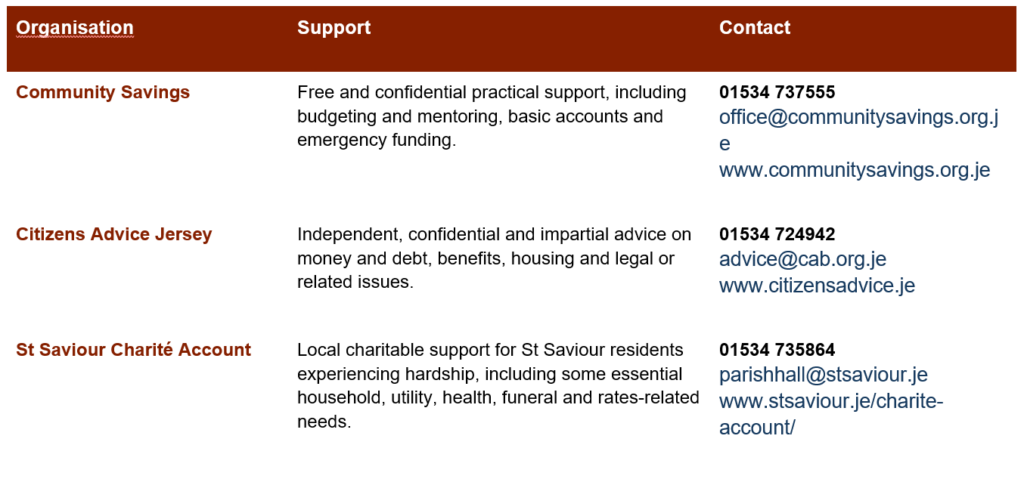
Support from another organisation is subject to that organisation’s own criteria and is not guaranteed. A referral does not suspend rates, surcharge or recovery unless the Parish confirms a temporary administrative hold. Personal information will be shared only with consent or another clear lawful basis
What May Constitute Hardship
Financial hardship means that paying the rates due, or paying them within a reasonable period, would cause material difficulty in meeting essential living needs or viable business obligations, taking account of the applicant’s overall financial position.
- Significant loss or reduction of income, including redundancy or business interruption.
- Illness, injury, disability or incapacity that materially affects income or essential expenditure.
- Bereavement, family breakdown, caring responsibilities or another major life event.
- Unexpected and unavoidable essential expenditure
- Low disposable income after reasonable essential expenditure.
- Limited access to savings, liquid assets or borrowing where using available resources would itself create serious hardship.
- Other exceptional circumstances that the Connétable considers relevant.
No single factor decides the outcome. The Parish will consider the nature, duration and severity of the difficulty, whether it is temporary or ongoing, and whether a sustainable payment solution is available.
The legal term is “hardship”, not only “financial hardship”. Serious non-financial circumstances that may justify relief will be referred to the Connétable for individual consideration.
Information We May Ask For
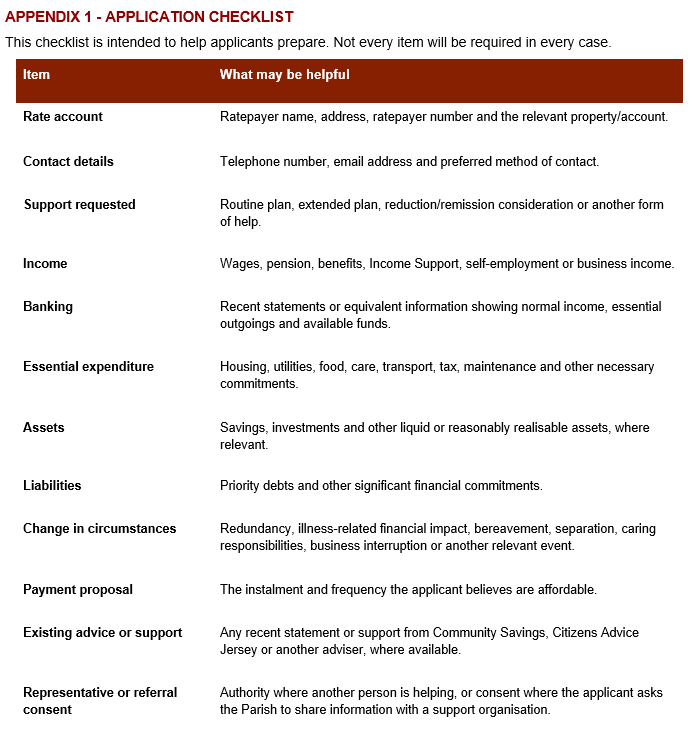
The information requested will depend on the support sought. A routine payment plan may be agreed following a discussion and basic information. More detailed financial information will normally be required for a plan extending beyond one year, repeated or substantially revised arrangements, or a request to reduce or remit rates.
- Recent bank statements or equivalent information showing normal income, essential outgoings and available funds; normally no more than three months unless the case is complex or incomplete.
- Evidence of wages, pension, benefits, Income Support, self-employment or business income
- A summary of essential household or business expenditure and significant liabilities.
- Information about savings, investments and other readily available assets where relevant
- Evidence of redundancy, loss of work, business interruption or another significant reduction of income
- Information showing the financial effect of illness, incapacity, bereavement or another relevant event, where necessary
Receipt of Income Support or other public assistance is relevant but does not automatically decide the outcome. With authority from the ratepayer, the Parish may accept a recent financial statement prepared by Community Savings, Citizens Advice Jersey or another suitable independent adviser to avoid unnecessary duplication.
How Applications Are Assessed
- Current and reasonably foreseeable income
- Essential expenditure and priority liabilities
- Available savings and liquid assets
- The amount and age of the rates debt
- The timing and quality of engagement, while taking account of vulnerability, communication barriers or another reasonable explanation for delay.
- Whether a realistic payment arrangement can resolve the position
- The effect of payment or recovery on essential living needs or continued viable business operation
- The interests of the wider ratepaying community.
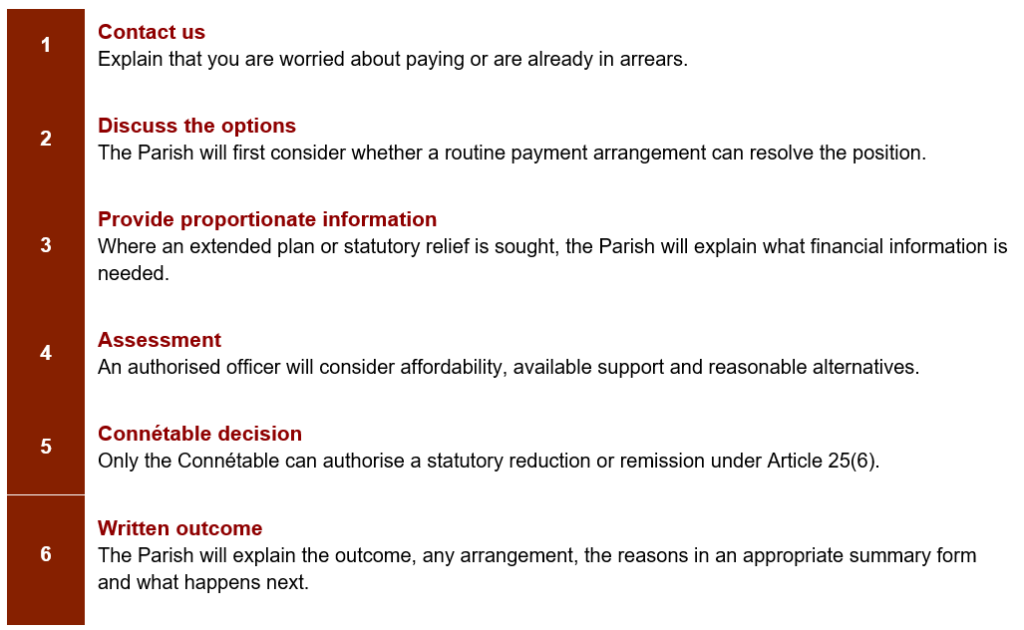
An authorised Parish officer will assess affordability and available administrative options. Where statutory reduction or remission may be appropriate, a recommendation will be prepared for the Connétable. The Connétable makes the final decision under Article 25(6).
Payment arrangements And Surcharge
Payment arrangements are the Parish’s main form of administrative support where the liability can reasonably be paid without severe hardship. Payment-plan and hardship forms are available on request, but a routine plan may also be agreed following a recorded telephone, email or in-person discussion.
- The arrangement will state the balance, instalment amount, frequency and expected end date
- The instalment must reflect affordability rather than an arbitrary amount.
- Where affordable, current-year liabilities should be addressed alongside arrears so that debt does not continue to increase.
- A plan may extend beyond one year where financial screening shows this is justified and sustainable
- Further adjustments may be considered sympathetically if circumstances materially change.
- The ratepayer should contact the Parish promptly if a payment cannot be made.
Surcharge reminder: If all or part of the rates remains unpaid three months after demand, a 10% surcharge becomes payable. A payment plan does not itself stop the surcharge. Any hardship relief relating to a surcharge must be considered and authorised as part of the Connétable’s Article 25(6) decision.
Reduction Or Remission Of Rates
Reduction or remission is exceptional because non-collection affects public finances. It may be appropriate where the Connétable is satisfied that hardship is established and a lesser option would not reasonably resolve the position.
- The severity and likely duration of the hardship.
- Whether payment would compromise essential living needs or create another serious injustice.
- Whether a sustainable arrangement is feasible within a reasonable period.
- The applicant’s available resources and whether assets are reasonably realisable.
- Any vulnerability or exceptional personal circumstances.
- The amount of relief sought and the effect on public funds.
- The applicant’s engagement and completeness of the information provided.
- Any other matter the Connétable considers relevant.
Relief is not limited by an absolute rule to owner-occupiers, domestic ratepayers or another single category. The nature of the property, the applicant’s circumstances and the public-interest implications may, however, be relevant. Any decision is specific to that ratepayer and does not establish a precedent for another case.
Circumstances That Will Not Normally Qualify
The following will not normally, by themselves, justify reduction or remission:
- Short-term cash-flow inconvenience where sufficient resources are available.
- A preference to pay non-essential or lower-priority expenditure before rates
- Failure to engage despite reasonable opportunities, unless vulnerability or other circumstances explain the delay.
- A dispute about rateable value or liability that belongs in the separate statutory review or appeal process
- Voluntary expenditure or financial commitments that are plainly disproportionate to available means
- Dissatisfaction with the level of Parish services or the rate set by the Parish Assembly
- Charitable, community or not-for-profit status on its own, without evidence that payment would cause hardship.
These are indicators only. The Connétable will still consider the full circumstances of an individual case.
How To Apply And What Happens Next
You may contact the Parish by telephone, email, in person or in writing. Forms are available on request, and reasonable help will be provided where someone cannot readily complete a form.
Decision target
The Parish will aim to issue an outcome within 14 working days after receiving sufficient information. Complex cases may take longer; the applicant will be told why and given an expected decision date.
An application or referral does not automatically suspend legal liability, surcharge or recovery. The Parish may place a temporary administrative hold on active recovery while a genuine request is assessed where this is proportionate.
Where another person raises concern about a ratepayer, the Parish will normally ask the ratepayer to contact us directly or will require the ratepayer’s authority before discussing the account or accepting personal information.
Review And Reconsideration
A ratepayer may ask the Parish to reconsider a hardship decision where relevant information may have been overlooked, circumstances have materially changed or new evidence may affect the outcome
- The request should normally be made within 20 working days of the decision.
- Where practicable, an officer who was not responsible for the original financial assessment will review the file.
- Where the original statutory decision was made by the Connétable, only the Connétable may change it.
- This is an internal reconsideration process and does not create a statutory right of appeal.
- Disputes about rateable value or assessment remain subject to the separate Rates Law procedures.
Recovery and Enforcement
The Parish has a duty to collect public revenue lawfully due. We will encourage communication, seek to resolve genuine difficulty constructively and use enforcement only where proportionate.
- Repeated reminders and reasonable opportunities to engage will normally be provided before external recovery action.
- A genuine request for assistance will be considered before avoidable escalation where circumstances permit, including after a missed payment or breached arrangement.
- Where there is no meaningful communication despite repeated reminders, or an arrangement has failed without explanation, the debt may be referred to an external recovery agent
- Before court proceedings, the Parish will normally provide a final opportunity to contact us unless delay would prejudice recovery or another legal reason requires urgent action.
- A summons or court proceedings are a last resort. Help may still be considered after proceedings begin, although legal costs or other consequences may not always be avoidable.
Joint Owners, Companies, Charities and Complex Cases
Hardship applications are not confined to individual owner-occupiers. Jointly liable ratepayers, companies, charities and other organisations may apply, although the information required will reflect the nature of the applicant and the account.
- Where more than one person is liable, the Parish may request information relevant to the account as a whole. An authorised representative may communicate on behalf of the liable persons, but this does not itself remove another person’s legal position
- A company or charity may be asked for recent accounts, cash-flow information, assets, liabilities and evidence of viability. Charitable status alone does not establish hardship
- Commercial hardship will normally be addressed first through payment arrangements or structured recovery, but statutory relief remains legally available where the Connétable considers hardship established.
- Cases involving insolvency, bankruptcy, désastre, dégrèvement, réalisation, deceased estates or another legally complex matter will be referred for appropriate professional advice
Confidentiality, Accessibility and Representation
- Applications and payment-plan information will be handled confidentially and only by those who need access for assessment, decision, accounting, audit, recovery or legal purposes
- Only relevant and proportionate personal and financial information will be requested.
- Detailed medical information will not be requested routinely; the Parish will seek only what is reasonably necessary to understand the financial effect.
- Reasonable help is available for forms, communication, language or accessibility needs.
- A ratepayer may authorise another person to assist or represent them, subject to appropriate authority and data-protection checks.
- Information will not be shared with a support organisation without consent or another clear lawful basis.
Contact the Parish
Telephone 01534 735864 | Email [email protected] | Parish Hall, St Saviour’s Hill, St Saviour, Jersey JE2 7LF. Please tell us that you are concerned about paying your rates and would like to discuss a payment plan or hardship support.